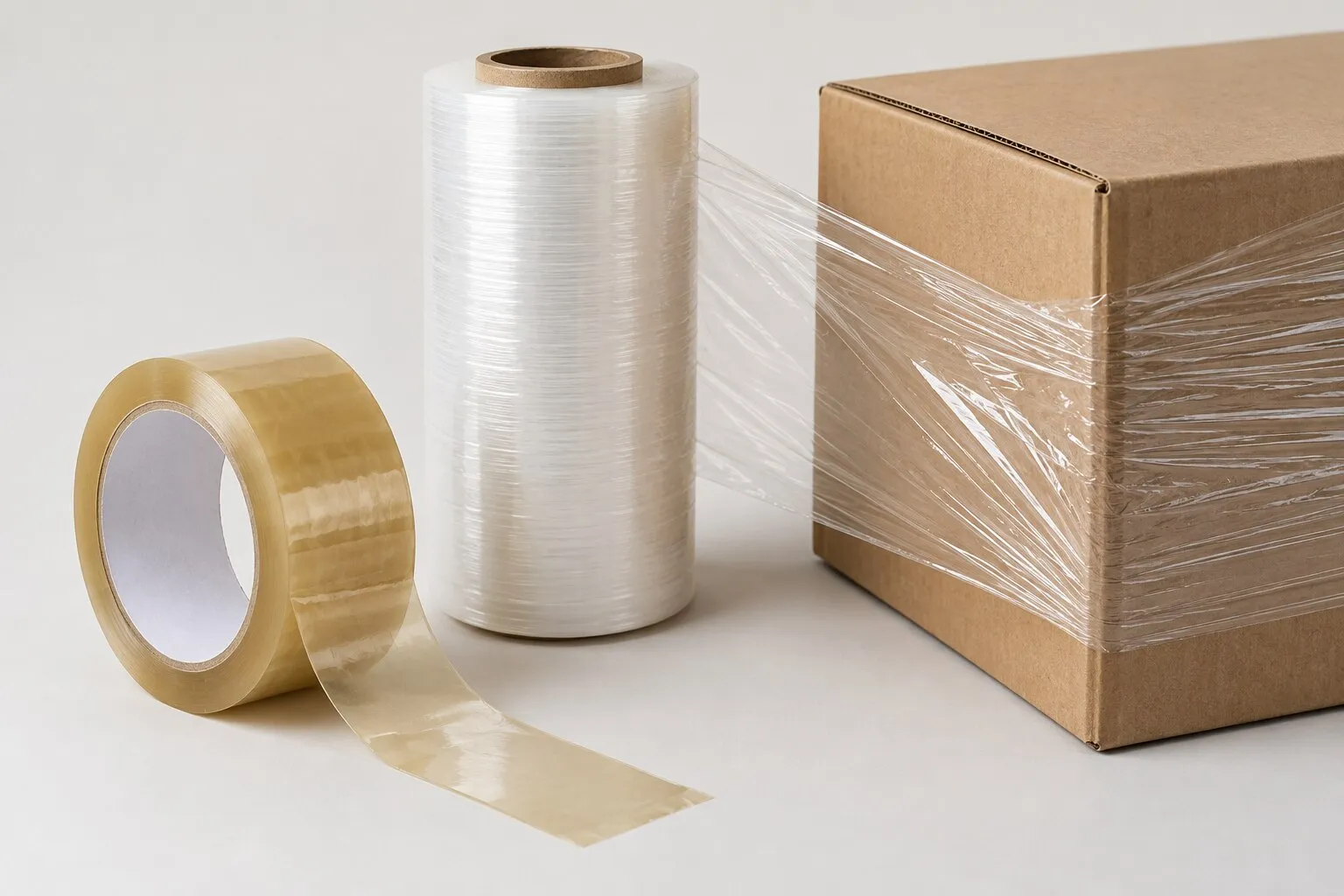
The choice depends on whether you need to bond or cushion one surface, or contain several packages as one stable load. By the end, you will be able to select the right material, specify the properties that matter, test it under Vadodara handling conditions, and compare the total cost of each option.
Key takeaways
- Use tape for a defined bond; use stretch film to contain grouped goods.
- Specify tape by adhesive, backing, width, thickness, and removal needs.
- Wrap pallets with overlapping tensioned layers and secure the film tail.
- Test materials on your cartons, loads, routes, heat, and humidity before switching.
Choose by the packaging problem: bonding one surface or containing one load
Tape is the right choice when you must bond, close, join, or cushion one defined surface or joint. Stretch film is right when elastic tension must contain multiple cartons, items, or a pallet. That is the decision rule behind single side adhesive tape versus stretch film.
| Option | Single-side adhesive tape | Stretch film |
|---|---|---|
| Purpose | Close, join, cushion | Unitise and stabilise |
| Adhesion | Bonds to a surface | Clings to itself |
| Containment | Does not restrain a grouped load | Resists carton movement |
| Surface contact | Defined strip or joint | Multiple wraps around the load |
| Suitable load size | One carton, panel, joint, or assembly | Cartons, pallets, and irregular loads |
| Removal | Peel from the applied surface | Cut and remove from the load |
| Puncture risk | Edge damage or tape split | Corners and protrusions can puncture film |
| Moisture exposure | Seal a joint against dirt or moisture | Adds a wraparound dirt and moisture barrier |
| Labour | Hand application | Hand wrapping or machine wrapping |
| Equipment | Dispenser or applicator | Film dispenser or wrapper |
| Likely waste | Tape, liner, and cores | Used film and cores |
Use tape for carton flaps, appliance panels, insulation joints, protected painted surfaces, and workshop assemblies. It preserves labels and barcodes on an individual carton. Use film for grouped cartons, palletised goods, irregular loads, transport staging, warehouse dispatch, and cold-chain unit loads when cartons shift against one another.
Treating them as interchangeable is a specification error, including when searching for single side adhesive tape or stretch film in vadodara. Choose based on the failure: an open joint needs tape; movement between packages needs film.
How to specify and apply single side adhesive tape without creating a removal problem
Check the substrate before applying tape: remove dust, oil, moisture, and loose coating, then let the surface dry fully. Initial tack can mislead you on corrugated board, cold metal, or low-surface-energy plastic.
- Clean the actual painted metal, plastic, insulation, powder coating, corrugated board, or other production substrate.
- Test compatibility on a hidden area. Include waxed coatings and low-surface-energy materials; these can prevent bonding or cause residue.
- Apply a sample with firm, even pressure across the full tape width. Insufficient pressure leaves air gaps and weak contact.
- Follow the supplier’s stated dwell time before handling or loading the joint.
- Store the sample for the expected period, then test removal for residue, coating lift, fibre tear, and surface damage.
- Reject the construction if dusty cartons, cold surfaces, waxed coatings, weak corrugate, or poor pressure cause edge lift, tearing, or adhesive transfer.
Ask for a written specification covering:
- Adhesive chemistry, liner type, peel adhesion, shear or holding power, tensile strength, operating temperature range, UV exposure limit, residue behaviour, roll width and length, and surface compatibility.
- Test references: ASTM D3330 for peel adhesion, ASTM D3654 for holding power, and ASTM D3759 for tensile strength and elongation.
If the tape is called food-grade, ask whether that means direct food contact or only incidental contact. Never approve production use from an immediate stick test alone.
How to wrap a pallet and choose stretch film that holds the load
Stretch film suits a pallet when elastic tension can hold several packages as one unit; start with a sound pallet and a load with no unstable overhang. A damaged pallet, sharp corner, or projecting carton can puncture film before containment develops.
- Wrap the bottom zone first, anchoring film around the pallet or lowest cartons. Overlap every pass and keep tension consistent.
- Continue through the middle and top zones, maintaining overlap and contact around corners.
- Secure the film tail against the load without leaving a loose flap. Reduce tension if cartons crush or product packaging distorts.
Specify the film by performance, not thickness alone. Request written values for LLDPE grade, gauge or microns, roll width and length, core diameter, net film weight, pre-stretch percentage, cling level and cling side, puncture and tear performance, transparency, colour, recommended wrap count, and retained containment force.
Cling joins film layers; it does not prove load containment.
| Film type | Best fit | Main control |
|---|---|---|
| Hand film | Low-to-moderate volume and variable loads | Operator tension and wrap count |
| Machine film | Repeatable loads and higher throughput | Controlled pre-stretch and consistent force |
A 23-micron roll is not automatically economical: low gauge can increase splits, rewrapping, and damaged goods. Check the finished pallet with ASTM D4169 distribution cycles or ISTA 3E unit-load testing when vibration, shock, and compression pose serious failure risks.
Build a Vadodara test before choosing a supplier or changing material
Run sample lots through the actual Vadodara handling cycle before approving a supplier or changing material. Recreate hot storage, monsoon humidity, warehouse dust, cold-chain temperatures, pallet movement, loading equipment, and the expected transport route; a room-temperature sample result is not a field result.
| Material | Record during the trial | Failure to investigate |
|---|---|---|
| Tape | Initial tack, dwell-time performance, seal strength, residue, edge lift, and removal damage on the actual substrate | Dust, cold surfaces, waxed cartons, weak corrugate, or insufficient pressure |
| Stretch film | Metres per pallet, wrap count, tension, corner punctures, split or tear points, retained containment, and carton movement after handling | Excessive tension, low retained force, or movement after loading |
Store both materials in their original packaging away from direct sunlight, heat, moisture, and dust. Allow each sample to acclimatise before use; poor storage can alter adhesive contact, film cling, and handling behaviour.
For a packaging material comparison in vadodara, request a written, lot-traceable specification instead of comparing labels such as “industrial tape” or “23 micron film.” Ask for substrate compatibility and adhesive data for tape; for film, request gauge, width, length, core dimensions, pre-stretch recommendation, cling side, puncture and tear data, wrap count, retained containment force, and lot number.
Greenline Industries can be included in a stretch film supplier in vadodara trial only after its samples are measured against the same route, load, and acceptance limits as competing materials. Approve recurring supply only when the trial records and specification match.
Related products
 | SINGLE SIDEADHESIVE TAPE Details Material:-EVA Foam / EDPM Color:- Black & White (Food Grade) Pack Type:- Roll Roll Width:- Customize Thickness:- 3mm - 5mm Roll Length:-... View product → |
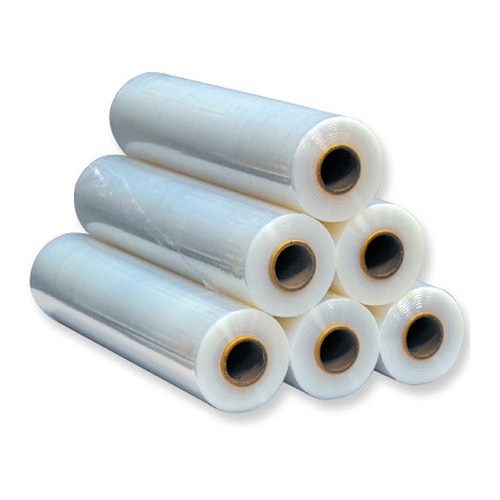 | STRETCH FILM Greenline Industries is a leading manufacturer and supplier of high-quality stretch films in India. View product → |
Compare total cost per sealed carton or stable dispatched load
A low roll price proves nothing until you calculate the cost per sealed carton or stable dispatched load. Record actual consumption: metres of film per pallet, or the number and length of tape pieces used per carton or joint, then divide by the output from each roll.
Measure these cost inputs for the same shipment:
- Operator minutes, including cutting, sealing, wrapping, and rework.
- Dispenser cost for tape, or wrapper cost and maintenance for machine film.
- Failed seals, unstable loads, damaged goods, replacement labels, and repairs.
- Disposal of used film, cores, tape liners, and rejected packaging.
- Cartons sealed or pallets wrapped per unit, not merely roll count.
| Measure | Tape | Stretch film |
|---|---|---|
| Output basis | Cartons or joints sealed per roll | Pallets wrapped per roll |
| Supplier quote | Indian rupees per roll, with length, width, and net weight | Indian rupees per roll, with width, length, core, and net weight |
| Labour basis | Pieces and application time per carton | Metres, wrap count, and operator time per pallet |
| Equipment | Dispenser and replacement blades | Hand dispenser or wrapper, including pre-stretch setting |
Do not compare hand-film and machine-film roll prices directly. Pre-stretch changes metres consumed, while machine speed changes labour and pallets completed per hour.
Choose tape when the failure is an open joint, loose flap, exposed edge, or surface contact. Choose stretch film when packages move against one another or pallet integrity is lost. Specify tamper-evident tape, security film, seals, or inspection procedures separately; ordinary tape and film are not security systems.
Frequently asked questions
When should you choose single side adhesive tape instead of stretch film?
Choose single side adhesive tape to close, join, bond, mark, or cushion one defined surface or joint. Choose stretch film when elastic tension must contain multiple cartons, items, or a pallet.
How should you specify single side adhesive tape?
State the backing material, adhesive type, width, thickness, roll length, required bond strength, application surface, temperature exposure, and whether clean removal matters. Test adhesion and residue on the actual carton or substrate.
How do you wrap a pallet with stretch film?
Anchor the film near the pallet base, overlap each pass, keep consistent tension, wrap the bottom and top zones securely, and finish with a pressed-down tail. Check that cartons do not shift when the load is pushed from the side.
What should a Vadodara packaging material test include?
Run the same tape or film on your actual cartons and loads through packing, storage, handling, and dispatch. Record application time, damaged cartons, film breaks, tape failures, residue, load movement, and material consumed.
How do you compare the total cost of tape and stretch film?
Measure material consumed and labour per sealed carton or stable dispatched load. Add rework, damaged goods, failed seals, equipment, storage, and disposal costs before comparing suppliers or changing material.
Keywords